 I haven’t been doing a lot of writing this year, a lot of reading yes, but very little writing. I am very deadline driven and since I’ve had no fiction writing classes this year my writing has taken a bit of a backseat. It hasn’t been a bad thing – I have read more books this year than I have in donkey ages, and since I really do believe that the more good stuff you read the more good stuff you will write, my year has been far from wasted.
However, I do need to write more so I joined an online critique group. The premise is actually really good. You earn ‘credits’ by reading and commenting (constructively) on other people’s work and once you have accrued enough credits you can upload your own piece for others to critique. I mainly joined to give me motivation to work on my novel (I hate saying that, it sounds so snobby, but I’m trying to be less weirded out about it) which I have been ignoring for quiet sometime. I joined a couple of months ago, critiqued some work, uploaded the first chapter of my novel, and then waited with a healthy mix of anticipation and excitement for the critiques to roll in.
On the whole I’ve found the community in this group really lovely – polite and professional. Some of the comments I’ve received have been extremely useful, some very flattering, and some a bit random. Rather what you would anticipate from any writers group that is primarily made up of amateur writers. However, one comment got me wondering about what we as writers expect from our readers.
To offer a little background – the main character in my novel is Kathryn. She is a mid-twenties English woman who is the product of an affair and was raised by her single mum. She is a very ‘detached’ person – detached from her family, detached (as in doesn’t take responsibility for) from some questionable behavior in her past, detached from any real purpose in her life. She ends up living in Arizona married to an older man, and with a step child who she is only 13ish years her younger. In the first chapter you are introduced to Kathryn at this point in her life, then an event happens that shakes her up, and sets in motion her finally taking responsibility for herself and her life. The Event happens at the end of chapter one, and I strongly believe that I need to use the bulk of chapter one to make the reader invested in the characters so that they themselves are affected when The Event occurs. Of course, this means chapter one is fairly non-eventful until the very end. But, non-eventful doesn’t mean not engaging – at least I hope!
One critique I received was positive about my writing style and the topic of the story but (and I’m paraphrasing here) that today’s reader wouldn’t be prepared to read for a whole seven minutes before The Event happened, and that because of movies/computer games etcetera they need faster gratification. Really? Seven minutes? Really? Do we expect so little of our readers these days? I’m not saying that the critiquer is incorrect – in fact he probably speaks a lot of truth but it saddens me to think that he may be right. Of course, it depends on who the reader is.
I love books that embrace language and character. I’m not plot driven so I can be very forgiving of a novel’s plot if the language wraps itself around me in a luscious hug, or if the characters are so well painted that they feel like people I’ve known my whole life. What I can’t read are plot driven books which give no consideration to language or character development – which rules out most ‘best sellers’, let’s be frank. But of course, it is a balance. The indulgence of language can ramble on for too long, and the character description can get way too detailed (I’m looking at you on both fronts, Victor Hugo!!)
One of the best books I’ve read recently is Trumpet by Jackie Kay, and it does a wonderful job of balancing the two worlds. There is plot though would probably be deemed ‘slow’ as there isn’t any action within the timeframe of the novel. It centers around a secret about the main character, Millie’s husband that becomes uncovered after his death (he dies before the novel starts). Kay then uses the rest of the novel to delve into how the reveal effects Millie and several other characters connected to Millie, including her son. But, nothing else happens as such, it is just a gorgeous book about how people cope when life slaps them in the face. However, it is certainly not a best seller – it was first published in 1998 and even in Kay’s native country, Scotland, it isn’t widely known.
Thus, as a writer, I need to decide who I want to write for. Am I writing for the best seller market that is swamped by high-action, straightforwardly-written stories that feed into this need for inpatient reading? Or do I write for the reader like me that will hang with a story as we weasel the plot out while reveling in the world the author creates with their words? I know this makes me sound snotty about ‘plot driven’ novels and I don’t mean to be that way at all – indeed these are the books that I will sit up all night and devour in one sitting, but they are typically not the ones I remember after a few months have past.
However, back to my first chapter. Although I don’t agree with the gentleman that I need to get to The Event in the first paragraph, I also don’t believe my first chapter is ‘right’ yet. I need to take on board a little of his sense that I need more conflict/foreshadowing or the like earlier in the chapter to hook the readers, but without sacrificing my integrity for my own love of language.
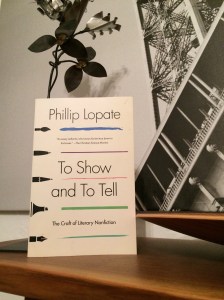 But what of writing non-fiction. I don’t mean a carefully researched article on a historical event, or a commentary on a topic of social importance but rather the ‘personal essay’. Non-fiction that is suppose to be a (re)telling of an event that truly happen in your non-fictional world – one that you, you know, actually lived through. In the last few months I have ventured into the world of the personal essay and it is, frankly, terrifying. Not because I’m worried about laying bare my ‘soul’ for critique by persons both known and unknown to me (you have to overcome that hurdle when you first do any form of creative writing), but, because, well, why would anyone want to read an essay about my life?

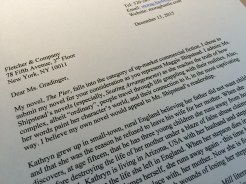 Although I was away from Ohio for the weekend I couldn’t completely tune out my life here for three days – aside from putting calls in to speak to the toddler and her Dada I had a homework exercise to complete for class. The exercise was simple, write a mock query letter looking for representation from a literary agent. To make it even more fun we were tasked with finding an actual real live, living & breathing agent that would be interested in the type of fiction we write. I first thought about Ian McEwan – cause who wouldn’t want his career! – but after some internet snooping I learned that the agent he worked with passed away last year. I poked through the company of the late agent but didn’t see a ‘perfect’ fit with any of the other agents.
 I could have a half hour warning of the incoming projectile and I still fumble the catch.

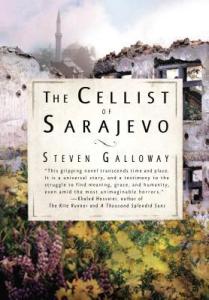 me in (yes, yes I know you aren’t suppose to ‘judge a book by its cover’ but hands up if actually don’t pick up books because you like their covers – anyone? anyone?) Flipping to the back cover to read the blurb I was sucked in even more and I duly headed to the checkout with book in hand. The book is The Cellist of Sarajevo by Steven Galloway and it was the image painted by the first sentence of the blurb that convinced me to spend my pennies. The sentence is this:
 For me it is about lowering myself into the pool at a slow enough rate that the frigid water doesn’t take my breath away – at least that is how I like to approach cold bodies of water, others like to take a running dive-bomb in but I am convinced my heart will stop on impact if I try that. So I look for friendly places where I can expose my writing for digestion. One of those friendly places I have found is a local writing group where the people are constructive with their suggestions and are a lot of fun to spend time with. Sadly, due to some transportation issues (who would have thought living in America in your late thirties and not holding a driving license would be problematic!) I haven’t really been able to attend since my daughter was born. And so when I recently learned that they are running a competition for the first time I had the sense that I really couldn’t not enter! But there is a small catch that is slowing me down – there is a theme that the entries have to abide by, superheroes.
 h the image of a man sitting in bed reading a newspaper and the story unfolded from there. I have been throwing images around in my head for ‘superheroes’ and to even come up with an image I like has been a struggle, far less an image I can unravel into a story. I don’t know why this theme is proving difficult for me, is it too general, is it too specific, does it relate too much to a genre of books I typically don’t read and I can’t find a way to connect? I finally landed on an image … that of a young girl dressed in a gold and black superhero costume surrounded by grownups in their best finery awaiting to attend the New York City Ballet opening gala. Now what? Something has to happen, right? A gunman starts shooting into the crowd and the little girl’s mother throws herself onto the girl to save her – blerugh, too much. A car crashes into a food cart and the little girl’s father rescues the vendor who is pinned under the car with superhero strength – blerugh, too clichéd. A homeless man … yeah, just blerugh.
 Morag Hastie